Nathaniel Prescott, Lead Wealth Strategist & Solo Columnist
June 29, 2026 · 13 min read
I lost my crypto to a fake Ledger: Verify your wallet seal
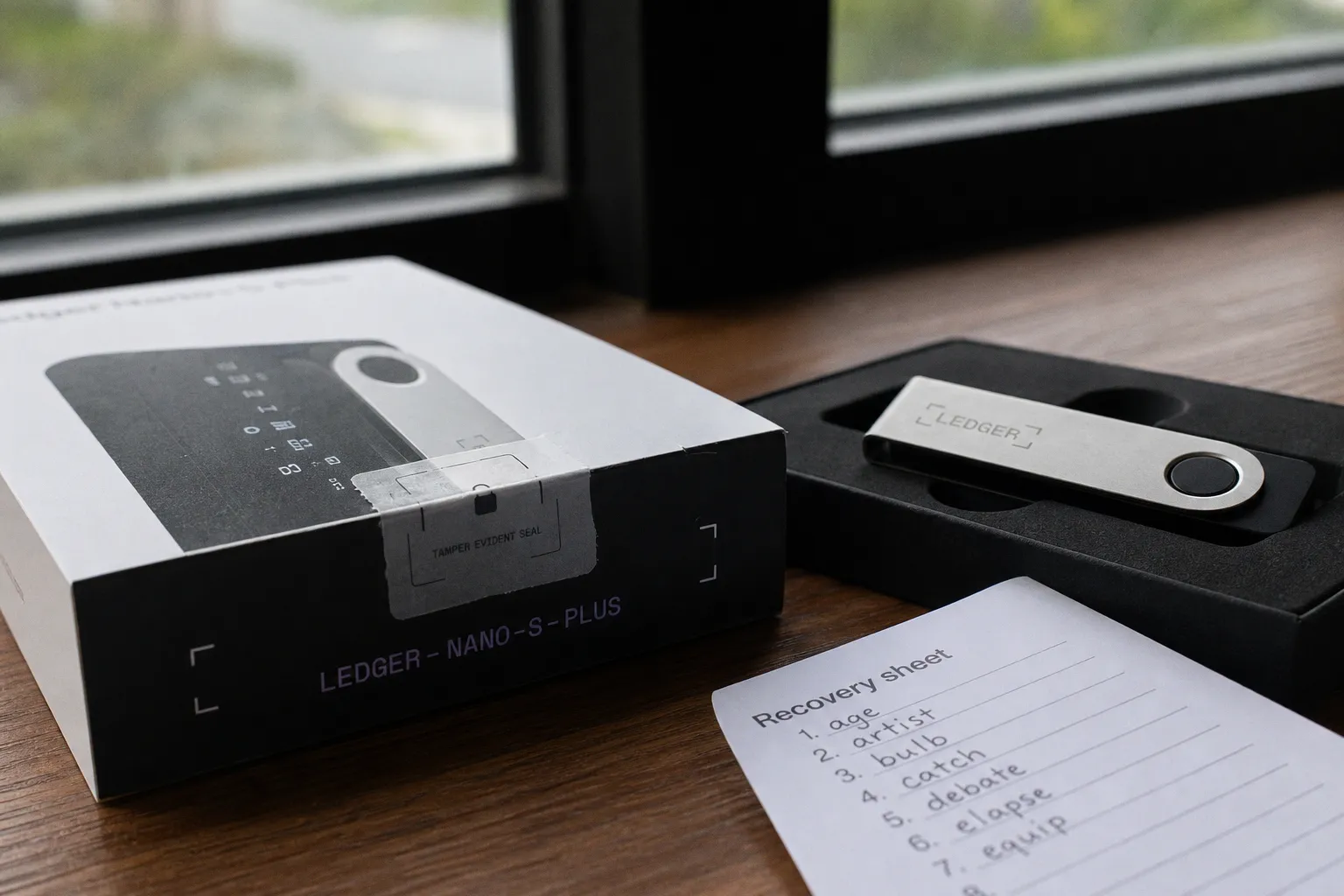
100%. That is the probability your funds are compromised if your Ledger arrives with a recovery sheet already filled in. Not "high risk." Not "likely." One hundred percent.
The $0 Recovery: Why a Tampered Hardware Wallet Is the Most Expensive Free Gift You'll Ever Receive
100%. That is the probability your funds are compromised if your Ledger arrives with a recovery sheet already filled in. Not "high risk." Not "likely." One hundred percent. There is no scenario, no edge case, no rare exception in which a pre-printed or pre-written 24-word seed phrase on a Ledger recovery sheet is anything other than a trap designed to drain every satoshi from your wallet the moment you transfer assets onto it.
We are past the era when hardware wallet scams were crude phishing emails with broken English. The attack surface has evolved into a fully industrialized supply chain operation. Counterfeit Ledger devices now arrive in packaging that is nearly indistinguishable from the real thing, complete with replicated security seals, legitimate-looking retail boxes, and sometimes even functional firmware that behaves normally during initial use. The trap activates later — when you move real funds onto what you believe is a secure device, and an attacker who already knows your seed phrase sweeps the wallet clean.
If you are holding crypto on a hardware wallet you purchased from a third-party marketplace — or even from an online retailer you assumed was authorized — you need to run a verification protocol right now. Not tomorrow. Not when you "get around to it." The asymmetric upside of doing nothing is zero. The asymmetric downside of being wrong is everything you hold.
The Anatomy of a Compromised Hardware Wallet
A tampered Ledger is not a defective product. It is a weapon engineered with a single objective: to exfiltrate your seed phrase. Understanding the attack vectors is the difference between detecting the threat before it activates and discovering your balance is zero.
The most common compromise operates on a simple principle. The attacker purchases a genuine Ledger device, modifies either the hardware or the firmware, then repackages it for resale through secondary markets. The device may function normally during initial setup — the screen powers on, the buttons respond, Ledger Live even connects to it. What the user does not realize is that the seed phrase generated (or, more critically, the one pre-supplied) is already known to the attacker.
Here is where the math gets brutal. A Ledger seed phrase is 24 words drawn from a standardized list of 2,048 words (BIP-39). The entropy of a properly generated 24-word phrase produces 2^256 possible combinations — a number so large that brute-forcing it is computationally infeasible even for nation-state actors. But entropy only protects you if the phrase was generated by a genuine, uncompromised device. If the phrase was pre-filled on a recovery sheet sitting inside your box, or if the device's random number generator has been tampered with, you are not protected by 256 bits of entropy. You are protected by exactly zero bits.
The attack surface breaks into three categories:
1. Pre-filled recovery sheets. The box contains a card with 24 words already printed or handwritten. This is the most blatant signal of compromise and the one most users miss because they assume it is "convenience packaging."
2. Tampered firmware. The device has been reflashed with modified firmware that generates predictable seed phrases or transmits them through side channels (USB data leaks, Bluetooth interception on models that support it).
3. Hardware modifications. Microcontroller replacements or added components that capture keystrokes, seed phrase entries, or PIN inputs and store them for later extraction.
Each of these requires a different verification approach. The first is detectable by any user who knows what to look for. The second requires cryptographic attestation through Ledger Live. The third is the hardest to identify without physically disassembling the device — which is why supply chain integrity at the point of purchase is your primary line of defense.
Why Physical Security Seals Are Not Enough
A security sticker on a box tells you exactly one thing: someone put a sticker on a box. It does not tell you whether the device inside was manufactured by Ledger, modified by a third party, or reflashed in a warehouse in Shenzhen.
This is the assumption that costs people the most money. Users see an intact holographic seal, a clean retail box with proper branding, and they conclude the product is genuine. This reasoning fails on a fundamental level because physical security seals are trivially replicable.
Holographic stickers, shrink wrap, and tamper-evident tape are consumer reassurance mechanisms, not cryptographic guarantees. They are designed to provide a visual signal that a package has not been opened — but that signal is only meaningful if the seal itself cannot be reproduced. In practice, counterfeiters source identical or near-identical seals. Some buy them in bulk from the same suppliers that legitimate manufacturers use. Others simply produce their own replicas that are close enough to pass a casual visual inspection.
The security model of a hardware wallet cannot rely on a $0.02 sticker. It must rely on the device's ability to prove, through cryptographic attestation, that it is running genuine firmware on unmodified hardware. This is why Ledger built the Genuine Check into Ledger Live — because they understood, correctly, that physical packaging is a weak security signal and that the real verification has to happen at the silicon and firmware level.
If you are still relying on "the box looked legit" as your security model, you are operating with a false sense of protection that is worse than having no protection at all. A false positive — believing a tampered device is safe — causes you to transfer assets onto it. An honest acknowledgment of uncertainty would at least cause you to pause.
The comparison is stark:
| Security Signal | What It Actually Proves | Confidence Level |
|---|---|---|
| Intact holographic seal | Someone applied a seal | Very low |
| Clean retail box with branding | Packaging was replicated or genuine | Low |
| Ledger Live Genuine Check passes | Device runs authentic Ledger firmware | High |
| Device generates seed phrase on-screen (not pre-filled) | Phrase was not predetermined | High |
| Purchased directly from Ledger.com | Device passed through Ledger's own supply chain | Highest |
Layer your verification. A sticker alone is a coin flip at best.
The Golden Rule: Why Genuine Devices Never Come Pre-Configured
This is the single most important sentence in this article, and it warrants a separate section because if you internalize nothing else, internalize this:
A genuine Ledger device will always ask you to generate a new 24-word recovery phrase during initial setup. It will never arrive with a phrase already created, pre-written, or suggested.
Not partially. Not "sometimes." Not "unless you bought a premium version." Never. There is no legitimate scenario in which your recovery phrase exists anywhere outside of your device's screen during the setup process. Not on a card in the box. Not in an email. Not on a PDF you were asked to download. Not on a scratch-off panel.
If your device arrives with any of the following, treat it as compromised with the same certainty you would treat a wallet with a known private key leak:
- A recovery sheet with words already filled in — 100% scam
- Instructions to enter a specific seed phrase "for security purposes" — 100% scam
- A QR code that allegedly contains your recovery phrase — 100% scam
- A prompt on the device asking you to enter an existing phrase during "setup" — high probability of tampering (genuine devices offer this only for wallet recovery, not initial setup)
The math here is binary. There is no 80% safe, no "probably fine." A pre-filled seed phrase means someone else knows your keys. And in crypto, whoever knows your keys owns your coins. Full stop. There is no customer support ticket, no chargeback mechanism, no regulator who can reverse a transaction signed by a compromised private key. The broader conversation around practical security measures and everyday decisions extends well beyond crypto — but in this specific domain, the margin for error is exactly zero.
The psychological trap is that a pre-filled sheet feels like a feature. "Look, they made setup easier!" No. They made theft easier. A genuine Ledger generates your phrase word by word on its own screen, asks you to write it down yourself, and then verifies that you did so correctly. That friction is not a design flaw. It is the entire security model.
Using Ledger Live's Cryptographic Attestation for Peace of Mind
Ledger Live includes a feature called Genuine Check, and this is the verification layer that actually matters. When you connect your device and run the check, Ledger Live communicates with the device's Secure Element chip and performs a cryptographic attestation — a process where the chip proves, through a challenge-response protocol, that it is running genuine Ledger firmware on hardware that has not been physically modified.
This is not a software version check. It is not a serial number lookup. It is a cryptographic proof tied to the physical silicon of the chip. The attestation chain originates from Ledger's manufacturing process and cannot be replicated by a counterfeiter who does not have access to Ledger's secure production infrastructure.
Here is how to run it properly:
1. Download Ledger Live exclusively from ledger.com. Verify the URL character by character. Phishing sites that mimic Ledger Live are a separate attack vector entirely — but if you start with a compromised application, every subsequent check is meaningless.
2. Connect your device via the USB cable that came in the box (or a cable you trust — a cable cannot tamper with cryptographic attestation, but a compromised cable is still an unnecessary risk variable).
3. Navigate to the Genuine Check feature within Ledger Live's device management section.
4. Complete the attestation process. The device will prompt you to confirm on its screen. Ledger Live will return a pass or fail result.
If the check passes, your device's firmware and hardware are consistent with a genuine Ledger product. If it fails, do not use the device. Do not "try again later." Do not update the firmware and hope for a different result. A failed attestation means the device is not what it claims to be.
One critical caveat: the Genuine Check verifies firmware and hardware integrity at the time of the check. It does not retroactively verify that your seed phrase was generated securely if you completed setup before running the check. This is why the correct sequence matters:
| Step | Action | Why It Matters |
|---|---|---|
| 1 | Purchase from Ledger.com or authorized retailer | Minimizes supply chain risk |
| 2 | Inspect packaging — reject any pre-filled recovery sheet | Catches the most obvious compromise |
| 3 | Run Genuine Check in Ledger Live before setup | Confirms firmware/hardware integrity |
| 4 | Generate seed phrase on-device, write it down yourself | Ensures phrase was not predetermined |
| 5 | Verify seed phrase through the device's built-in check | Confirms transcription accuracy |
Steps 2 through 4 are non-negotiable. Skipping any one of them means you are trusting assumptions instead of verification. And assumptions are how balances go to zero.
Mitigating Supply Chain Risks: Where to Buy Your Hardware
The question I get most often is: "Does it really matter where I buy my Ledger?" The answer, with no hedging, is yes. It is the single highest-leverage decision in your hardware wallet security model.
Every intermediary between Ledger's production facility and your hands is a potential point of compromise. This is not paranoia — it is basic supply chain risk assessment. Each additional party that handles the product introduces a vector for tampering, substitution, or interception. The probability of compromise increases multiplicatively with each intermediary, not additively.
Ledger.com directly. This is the baseline. Ledger ships from its own distribution centers, maintains chain of custody from production to delivery, and the product passes through a controlled number of handling points. The risk is not zero — nothing is — but it is the lowest available probability of supply chain compromise.
Authorized retail partners. Ledger maintains a list of authorized resellers. These are entities that have a direct procurement relationship with Ledger and whose supply chain Ledger has vetted to some degree. The risk is marginally higher than direct purchase because the product passes through an additional distribution layer, but the Genuine Check provides a strong cryptographic backstop.
Third-party marketplaces (Amazon third-party sellers, eBay, AliExpress, Facebook Marketplace). This is where the risk curve goes vertical. You have zero visibility into the supply chain. The seller may be legitimate. They may be selling counterfeit units. They may be selling genuine units that were intercepted and tampered with before resale. You cannot distinguish between these scenarios from a product listing.
The opportunity cost calculation is straightforward. A Ledger Nano costs between $79 and $149 depending on the model. The cost of a compromised device is your entire crypto portfolio — not a hypothetical "potential loss," but a near-certainty that funds moved onto a tampered device will be drained. The expected value of saving $20 by buying from an unauthorized seller versus buying direct from Ledger is deeply negative.
Here is the decision tree, stripped to its core:
- If you can afford crypto, you can afford to buy the device from the manufacturer. There is no rational economic argument for cutting corners on the one device that stands between your assets and a permanently adversarial network.
- If you already own a Ledger purchased from a third party, run the Genuine Check immediately. If it passes, generate a new seed phrase on the device (after resetting it to factory settings) and transfer your assets to the new addresses. Do this now, not when you "have time."
- If the Genuine Check fails, or if your device arrived with a pre-filled recovery sheet, assume the device is compromised. Do not transfer any assets to it. Contact Ledger support to report the counterfeit, and source a replacement directly from Ledger.com.
The Binary Choice
We can dress this up with nuance, but the conclusion is a fork in the road with only two directions.
Direction one: You verify your device. You run the Genuine Check. You confirm the seed phrase was generated on-device and known only to you. You bought from Ledger.com or an authorized retailer. Your security model is grounded in cryptographic proof, not visual inspection of stickers.
Direction two: You trust the box looked real, the seal seemed intact, and the seller had good reviews. Your security model is grounded in hope.
Hope is not a strategy. It is not an asset class. It does not compound.
The mechanics of securing a hardware wallet are not complex. They require attention, sequence discipline, and an unwillingness to accept convenience over verification. Every step in this article is a filter that reduces your probability of compromise. Stack enough filters, and you approach the only acceptable target: zero.
Your keys, your coins. Someone else's keys, someone else's coins. There is no third option.