Nathaniel Prescott, Lead Wealth Strategist & Solo Columnist
July 01, 2026 · 13 min read
Compare IRS gold depository fees to avoid hidden IRA costs
Here's a number that should make you uncomfortable: a $200,000 gold IRA can quietly lose $1,200 to $1,800 annually to fees you never explicitly agreed to—not in any single line item, but buried…
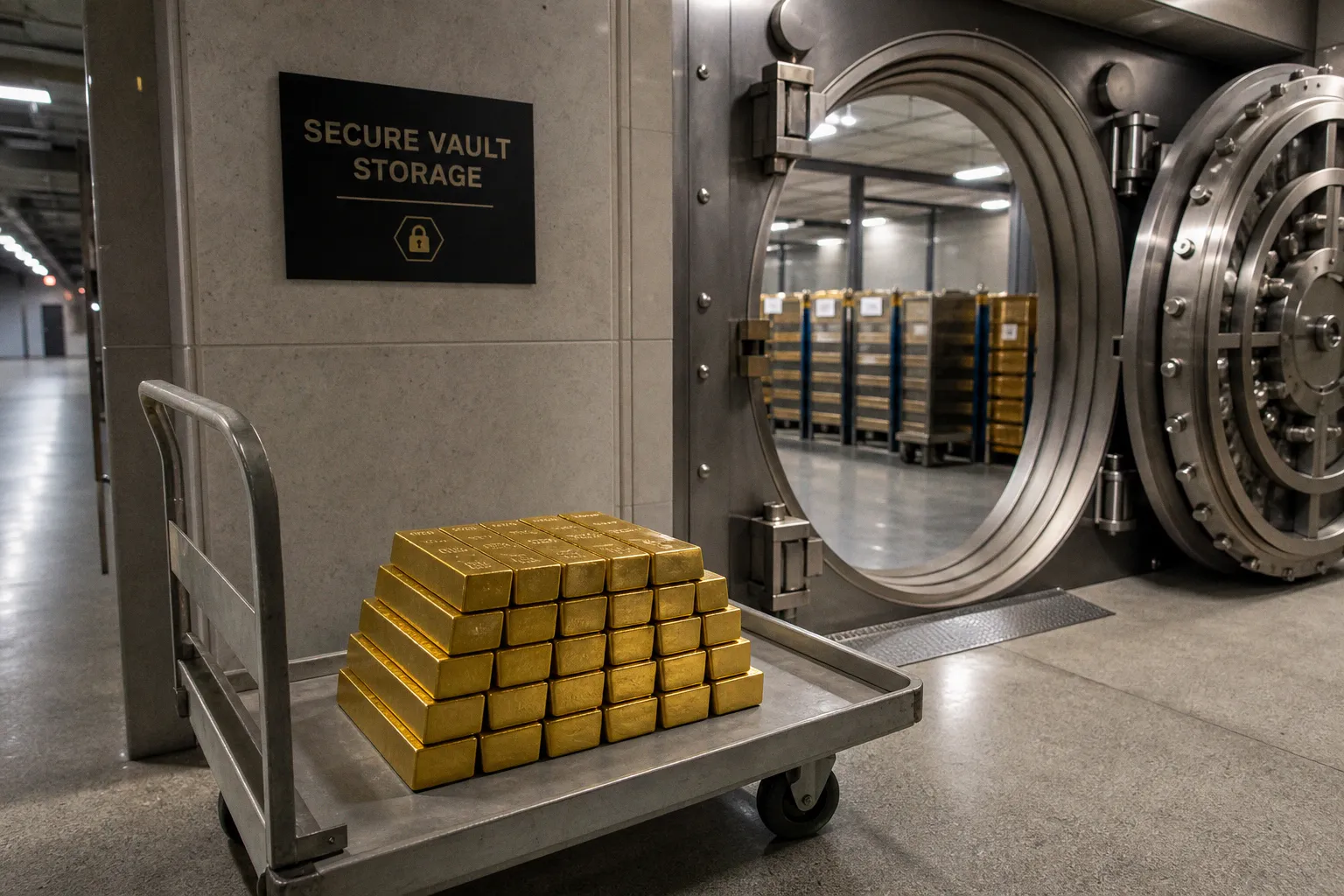
The $200,000 Account Paying $1,800 a Year to Sit in a Vault
Here's a number that should make you uncomfortable: a $200,000 gold IRA can quietly lose $1,200 to $1,800 annually to fees you never explicitly agreed to—not in any single line item, but buried across three separate intermediaries who each take their cut while you sleep. That's not a rounding error. Over a decade, before accounting for opportunity cost, you've handed over $12,000–$18,000 for the privilege of holding a metal that doesn't generate yield, doesn't pay dividends, and doesn't compound. The only variable you control is how efficiently you structure the custody chain. Most investors don't even know there's a chain to audit.
This isn't about whether gold belongs in your retirement portfolio. That's a separate allocation argument. This is about the mechanics—specifically, the fee architecture that surrounds physical gold inside a Self-Directed IRA (SDIRA) and the ways it silently erodes the very wealth you're trying to protect. If you've already committed to holding physical metal in a tax-advantaged account, your job is to minimize the drag. Full stop.
Let's break the structure apart, layer by layer.
The Anatomy of Gold IRA Fee Structures: Custodians vs. Depositories
First, dispel the notion that there's one entity "holding your gold." There isn't. A gold IRA involves a minimum of three distinct parties, each charging independently:
1. The IRA Custodian — The IRS-qualified trustee that administers your account. This is the entity that handles reporting, ensures compliance, and processes transactions. They don't touch your gold. They touch your paperwork. Custodial fees typically break down as:
- Account setup fee: $50–$150 (one-time)
- Annual maintenance fee: $75–$300
- Wire transfer fees: $25–$50 per transaction
2. The Precious Metals Dealer — The company that sells you the gold. This is where margins get wide and transparency gets thin. We'll dissect their pricing model in a later section because it deserves its own reckoning.
3. The IRS-Approved Depository — The physical vault where your metal sits. The IRS mandates that IRA-held gold must be stored in a qualified depository—your home safe, your bank deposit box, your sock drawer are all prohibited. Violate this rule and the IRS treats the entire account as a distribution. That means income tax on the full value, plus a 10% early withdrawal penalty if you're under 59½.
You're not paying one entity to hold your gold. You're paying three entities to play their assigned roles in a regulatory chain—and each one prices its piece independently.
The critical insight: these three cost layers are not coordinated. Your custodian doesn't negotiate your storage rate. Your dealer doesn't care what your custodian charges. You are the only party with a financial interest in optimizing the total sum. Treat these as line items in a single budget, because that's exactly what they are.
One more layer that often gets overlooked: the custodian and the depository may have a referral relationship that benefits them both but costs you more than it should. Some custodians steer clients toward affiliated or preferred depositories that charge above-market rates. The custodian gets a referral fee or a bundled discount; you get a storage bill you never thought to question. This is why the audit process—outlined later—must treat every party as an independent cost center.
Decoding Storage Costs: Flat Annual Fees Versus Asset-Based Pricing
Depository storage fees fall into two fundamentally different pricing models, and the one that's cheaper depends entirely on the size of your holdings. This is where most investors get it wrong—they compare headline rates without doing the math that actually matters.
Flat Annual Fee: A fixed dollar amount charged regardless of portfolio size. Typically $100–$300 per year.
Asset-Based Fee: A percentage of total holdings, usually between 0.05% and 1% annually.
Here's the crossover math:
| Account Value | Flat Fee ($250/yr) | Asset-Based (0.5%) | Asset-Based (1.0%) |
|---|---|---|---|
| $25,000 | $250 | $125 | $250 |
| $50,000 | $250 | $250 | $500 |
| $100,000 | $250 | $500 | $1,000 |
| $250,000 | $250 | $1,250 | $2,500 |
| $500,000 | $250 | $2,500 | $5,000 |
The pattern is obvious once you stare at it: flat fees favor larger accounts; percentage-based fees favor smaller ones. If you're holding $50,000 or less in gold, an asset-based rate below 0.5% is probably the better deal. Cross $100,000 and a flat fee structure starts saving you real money—hundreds per year, compounding into thousands over a holding period.
The problem: many depositories don't advertise their pricing model prominently. Some quote a flat fee publicly but switch to asset-based pricing above a certain threshold. Others bundle storage into a "total annual fee" alongside custodial charges, making it nearly impossible to isolate the storage component without asking direct questions. A few depositories charge a flat fee for "allocated" storage (your specific bars, segregated by serial number) but offer a lower asset-based rate for "commingled" storage (your gold sits in a shared pool with other clients' metal). The tradeoff there isn't just cost—it's recoverability. With allocated storage, you can retrieve your exact bars. With commingled, you receive equivalent metal, which introduces a layer of counterparty risk most investors never consider.
Your move: call the depository. Ask explicitly—"Is my storage fee flat or percentage-based, and does that structure change at any account threshold? Is my metal allocated or commingled?" If they can't answer clearly, that tells you everything you need to know about their transparency.
The Hidden Impact of Dealer Spreads on Your Retirement Capital
Storage fees are visible. Dealer spreads are where the real money disappears.
When you buy gold through a precious metals dealer for your IRA, you're not paying the spot price. You're paying spot plus a spread—the dealer's markup. This spread is the single largest fee in the entire gold IRA chain, and it ranges from a reasonable 3% to a staggering 30%+ depending on what you buy.
The spread varies dramatically by product type:
| Product | Typical Spread Above Spot |
|---|---|
| Standard gold bullion bars (1 oz+) | 3%–5% |
| Popular bullion coins (American Eagle, Canadian Maple Leaf) | 5%–8% |
| "Semi-numismatic" coins | 10%–20% |
| "Collectible" or "limited edition" coins | 20%–35% |
Notice the escalation. That "semi-numismatic" and "collectible" category is where dealers make their real margins—and it's the category they push hardest. There's a reason for that: the IRS allows certain gold coins in IRAs (American Gold Eagles, Canadian Maple Leafs, certain bars meeting 99.5% purity standards), and within that approved list, dealers have enormous latitude to steer you toward higher-spread products.
The spread between spot price and what you actually pay is the largest single cost in a gold IRA—and the one your dealer is least motivated to disclose.
Here's a concrete scenario: you roll over $150,000 into a gold IRA and the dealer sells you "premium" coins at a 15% markup. You've just paid $22,500 above metal value on day one. Before gold appreciates a single dollar, you're $22,500 in the hole. At a 5% spread on standard bullion, that same purchase costs $7,500 in markup. The difference—$15,000—gone. It doesn't show up on any annual statement. It happened at the point of sale, and it's the reason your dealer took your phone call so enthusiastically.
The fix is mechanical: buy standard bullion products with the lowest verifiable spread. American Gold Eagles, Canadian Maple Leafs, or standard 1-ounce bars from recognized refiners. When a dealer suggests anything with the word "rare," "limited," or "collector" in the name, that's your signal to end the conversation.
There's a behavioral reason this works against you: dealers frame specialty coins as "protection" or "upside potential." In reality, the inflated premium is the product. The gold inside a $2,800 "collector" coin and a $2,050 standard Eagle is functionally identical for retirement purposes. The coin doesn't know it's rare. Your IRA doesn't care about mintage numbers. You're buying metal weight at the lowest cost, and anything that increases your per-ounce price is a tax on your retirement that compounds silently.
Navigating Mandatory IRS Compliance and Custodial Requirements
The IRS doesn't care about your storage preferences. It cares about traceability, custody, and tax compliance. The rules are rigid, and the penalties for getting them wrong aren't graduated—they're binary and punitive.
What the IRS requires:
- Your gold must be held by a qualified trustee or custodian—not by you personally.
- Storage must occur in an IRS-approved depository. Full stop. Home storage is not permitted under any circumstance for IRA-held metals. Some dealers market "home storage IRA" setups using LLC structures; the IRS has flagged these as abusive transactions. If you're audited, the entire account can be reclassified as a distribution.
- Only specific gold products qualify: coins and bars meeting fineness requirements (99.5% purity for gold, with the American Gold Eagle being a statutory exception at 91.67%).
What this means for your fee analysis:
Compliance isn't optional, so the custodial and storage fees are non-negotiable in structure—you must pay them. But the amount is negotiable by choice of provider. The IRS doesn't set storage rates. It sets storage requirements. The market sets the price, and the market has significant variance.
When you're evaluating custodians, the compliance function is table stakes. Every IRS-qualified custodian meets the same regulatory bar. The differentiator is cost, service responsiveness, and—critically—the reporting clarity they provide. A good custodian gives you an itemized annual statement that breaks down custodial fees, storage fees, and transaction fees separately. A bad one lumps everything into a single "annual account charge" and hopes you never ask what's inside it.
Beware of custodians who advertise "flat-rate" or "transparent" pricing but then layer in ancillary charges that don't appear on the headline fee sheet: account termination fees ($50–$250), partial distribution processing fees ($25–$75), paper statement surcharges, and even "special handling" fees for transactions above a certain dollar amount. These aren't hypothetical—they're documented across multiple custodial agreements. The annual maintenance fee is the one everyone quotes. The nickel-and-dime schedule is the one nobody reads.
Here's what a clean audit of your gold IRA fee schedule looks like when you stack the layers:
1. Custodian setup fee — one-time; negotiate or shop for waivable promotions
2. Custodian annual maintenance — $75–$300; flat, compare directly
3. Wire/transaction fees — $25–$50 per transfer; minimize by batching purchases
4. Depository storage — flat vs. asset-based; match to your account size
5. Dealer spread at purchase — the single largest cost; minimize by product selection
6. Dealer spread at sale — yes, you pay a spread on exit too; confirm it upfront
If you can't fill in all six numbers for your current gold IRA setup, you don't have a complete picture of what you're paying. And if you don't have a complete picture, you're overpaying by definition.
Strategic Steps to Audit Your Gold IRA Fee Schedule
Whether you already hold a gold IRA or you're shopping for your first one, the audit process is identical. It's not complicated, but it requires asking specific questions and rejecting vague answers.
Step 1: Get the full fee disclosure in writing. Before signing anything—before transferring a single dollar—request a written fee schedule from the custodian and the depository. Not a marketing brochure. A line-item fee document. If they send you a PDF with "call for pricing" on the storage line, keep calling until you get numbers.
Step 2: Isolate the spread on your metal. Ask the dealer: "What is my all-in price per ounce versus the current spot price?" Calculate the percentage. If it exceeds 8% for standard bullion, you're paying a premium you don't need to pay. If it exceeds 15%, you're being steered into a high-margin product.
Step 3: Model the 10-year cost. Take your current (or projected) account value, apply each fee, and sum them over a decade. The math is simple—use a spreadsheet, not intuition. For a $150,000 account with a 0.5% asset-based storage fee, $200 annual maintenance, and a 6% purchase spread, your 10-year drag exceeds $14,000 before gold moves a cent. If you'd bought standard bullion at a 4% spread with flat $200 storage, that drops below $9,000. That's a $5,000 difference on the same metal, achieved purely through fee discipline.
Step 4: Ask about exit costs. Most gold IRA investors fixate on the buy side and ignore the sell side. When you liquidate, the dealer buys back at spot minus a spread—typically 1%–3% for standard bullion, higher for specialty products. Confirm this rate before you purchase. A 3% exit spread on a $150,000 liquidation is $4,500 walking out the door.
Step 5: Compare at least three providers on total cost, not individual line items. The cheapest custodian might pair with the most expensive depository. The lowest-spread dealer might require you to use their preferred (and overpriced) custodian. Total cost is the only metric that matters.
Step 6: Check complaint history. The Consumer Financial Protection Bureau (CFPB) complaint database, state attorney general records, and Better Business Bureau filings give you a window into how a company handles disputes. Gold IRA dealers and custodians with patterns of undisclosed fees, delayed transfers, or unresponsive service will show up there. Ten minutes of research can save you a decade of regret.
You're not choosing a gold dealer. You're choosing a fee structure. The metal is identical everywhere—only the markup changes.
The Binary Choice
Here's where we land. A gold IRA is a legitimate vehicle for holding physical metal in a tax-advantaged wrapper. But it's wrapped in a fee ecosystem that, left unchecked, will consume a meaningful percentage of your returns over time. Gold doesn't generate income. It doesn't pay you to wait. Every dollar you lose to excessive spreads, opaque storage charges, and layered custodial fees is a dollar that compounds against you, not for you.
You have two paths. Path one: accept the first fee schedule you encounter, buy whatever the dealer recommends, and hope the gold price rises fast enough to outpace the drag. That's what most people do, and it's why the fee burden on gold IRA investors is structurally higher than it needs to be—a drag built not from the metal itself but from the layers of intermediaries between you and your allocation.
Path two: treat the fee structure with the same rigor you'd apply to an expense ratio on a mutual fund. Demand line-item transparency. Buy standard bullion at verifiable low spreads. Match your storage pricing model to your account size. Run the 10-year math before you commit.
Gold in an IRA isn't a set-and-forget allocation. It's a cost-management exercise. The metal does its job. Your job is to make sure the middlemen don't eat it alive.